
HOUSE ARMED SERVICES RELEASES DRAFT NDAA
Today, the House Armed Services Committee released their draft of the 2027 National Defense Authorization Act (NDAA) (view the bill text here) ahead of the full committee markup of the NDAA scheduled for Thursday, June 4th at 10:00am ET (click here to tune in to the hearing). See some key details of the NDAA and how they compare to the DOE FY'27 Budget Request below:
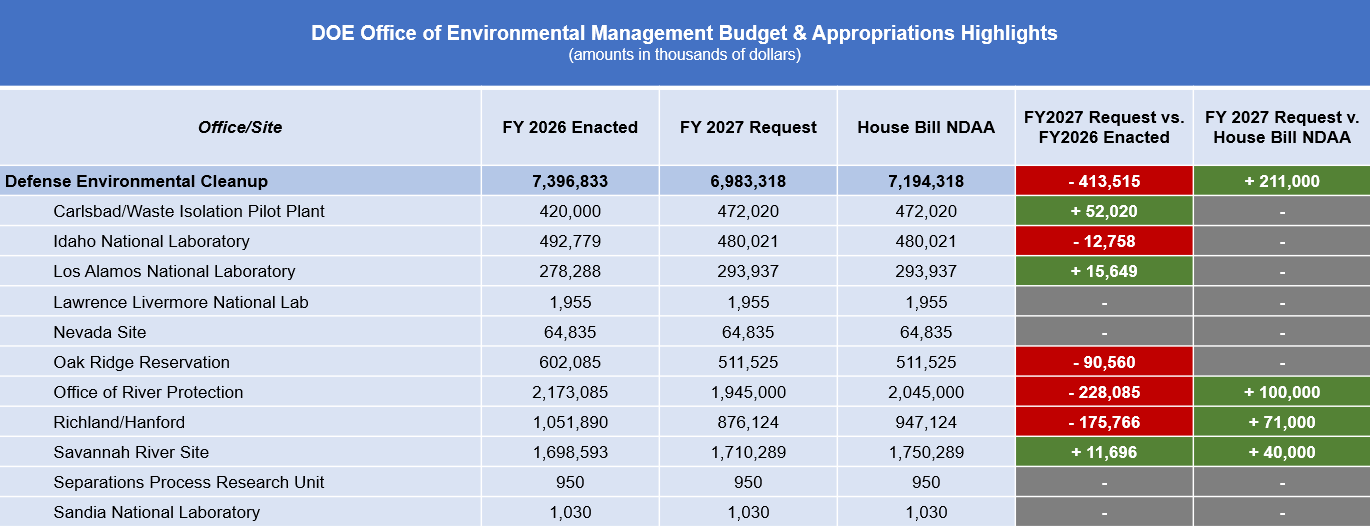
Of some of the authorizations included in the bill of interest to ECA, three sites saw increases in budgets from the President’s Budget Request: The Office of River Protection (+$100,000), Richland/Hanford (+$71,000), and Savannah River Site (+$40,000).
Below are additional details of the House text of the NDAA:
Space Force
Nuclear Fission Power to Enable Dynamic Space Operations
The committee recognizes the potential high-power nuclear fission could have on future Space Force requirements for sustained in-space operations, and as the Department’s reliance on maneuverable and power-intensive systems increases, enduring and resilient power generation will be essential to support offensive and defensive space control, long-duration mobility, high-duty-cycle sensing, secure communications, and autonomous operations.
Therefore, the committee directs the Secretary of Defense, in coordination with the Director of the Defense Advanced Research Projects Agency, the Secretary of the Air Force, and the Chief of Space Operations, to provide an unclassified briefing, with a classified annex, if necessary, to the House Committee on Armed Services Committee not later than March 1, 2027, on the Department’s plan to develop and field operational nuclear fission power systems for in-space operations. The briefing should include:
(1) operational nuclear fission power requirements across anticipated Department of Defense missions, to include in low-earth orbit, mid-earth orbit, geosynchronous orbit, cislunar space, and other deep-space environments;
(2) an assessment of barriers and capability gaps that have prevented previous nuclear fission efforts from conducting in-space deployment and testing;
(3) an overview of previous congressional funding and Department expenditures related to in-space nuclear fission capabilities since fiscal year 2017;
(4) a proposed architecture and acquisition pathway for operational in space nuclear fission power capabilities, including technology maturation milestones, test and evaluation plans, and integration with Space Force programs;
(5) a funding and resource plan identifying need investments through fiscal year 2035, including opportunities for interagency and commercial collaboration, to deliver an in-space nuclear fission power capability; and (6) a risk assessment, and mitigation options, for deploying in-space nuclear fission power capabilities.
NNSA in House Defense Authorization Mark
Material Staging Capability
The committee notes that the budget request included $22.5 million to support preliminary design activities for the Material Staging Capability project at the Pantex Plant. The committee supports the National Nuclear Security Administration’s (NNSA) renewed focus on this project, which will address documented mission needs to improve security and operations for stockpile modernization, surveillance, and dismantlement activities at the site. While the committee appreciates that the NNSA continues to refine its conceptual design, in support of establishing a cost and schedule baseline for the project, the committee is concerned by the absence of resources for this effort in the Future Years Nuclear Security Program.
Therefore, the committee directs the Administrator for Nuclear Security to provide a briefing to the House Committee on Armed Services not later than April 15, 2027, on the status of the Material Staging Capability project, including a finalized conceptual design and initial cost estimate. Next-Generation Pulsed Power Capabilities The committee recognizes the ongoing cooperation between the National Nuclear Security Administration (NNSA) and commercial industry with respect to next-generation fusion technologies and high-yield experimentation capabilities. The committee encourages NNSA to continue to look for opportunities to increase this collaboration as it works to define technical requirements related to future high-yield experimentation needs. Accordingly, the committee directs the Administrator for Nuclear Security to provide a briefing to the House Committee on Armed Services not later than March 1, 2027, on NNSA’s long-term experimentation requirements in high-yield physics regimes and related partnership opportunities with commercial industry.
Procurement of U.S.-Origin Uranium
The committee remains concerned about domestic capacity to supply unobligated and unencumbered uranium to meet national security mission needs. Therefore, the committee directs the Administrator for Nuclear Security to provide a briefing to the House Committee on Armed Services by March 1, 2027, on the National Nuclear Security Administration’s plans with respect to the availability and procurement of U.S.-origin unobligated and unencumbered uranium for defense mission needs. The briefing shall include the following: (1) a summary of current and projected domestic uranium mining and conversion capacity; (2) an analysis of projected requirements for unobligated, unencumbered, domestic uranium to meet national security missions; (3) an assessment of how projected increases in domestic and global commercial demand for mined uranium and conversion services may affect availability of U.S.-origin uranium; (4) an overview of NNSA’s ongoing coordination with other relevant government stakeholders on domestic uranium availability; and (5) options and recommendations for procurement of U.S.-origin uranium and conversion services, including consideration of a strategic uranium reserve concept.
ECA will continue to provide updates and analysis on this bill as they develop. To stay up-to-date on the current appropriations and authorization process, visit the newly updated ECA Federal Budget Tracker.